We Added Years to Life. Now What?
Theme: Gender Equality (Women’s Health)
We have extended life faster than we have extended our imagination of it.
Seventy and eighty still carry cultural meanings inherited from another era: retirement, withdrawal, dependency and approaching the end of life.
The facts tell a different story.
In 2000, only 9.4% of American women 65+ participated in the labor force. By 2025, that had risen to 15.7%. Among women ages 65–69, participation increased from 19.5% to 28.9%. And the U.S. Bureau of Labor Statistics projects participation among women 65–74 will continue rising through 2034.
Work is only one signal.
Among Americans over 50, 79% say having a clear sense of purpose is very important, and 77% are interested in learning how to create and maintain purpose in their lives.
Put these facts together and a different picture emerges.
We are not simply producing more older women. We are creating a longer adult life.
A Life Stage We Haven’t Designed For
For generations, we organized life around a familiar sequence:
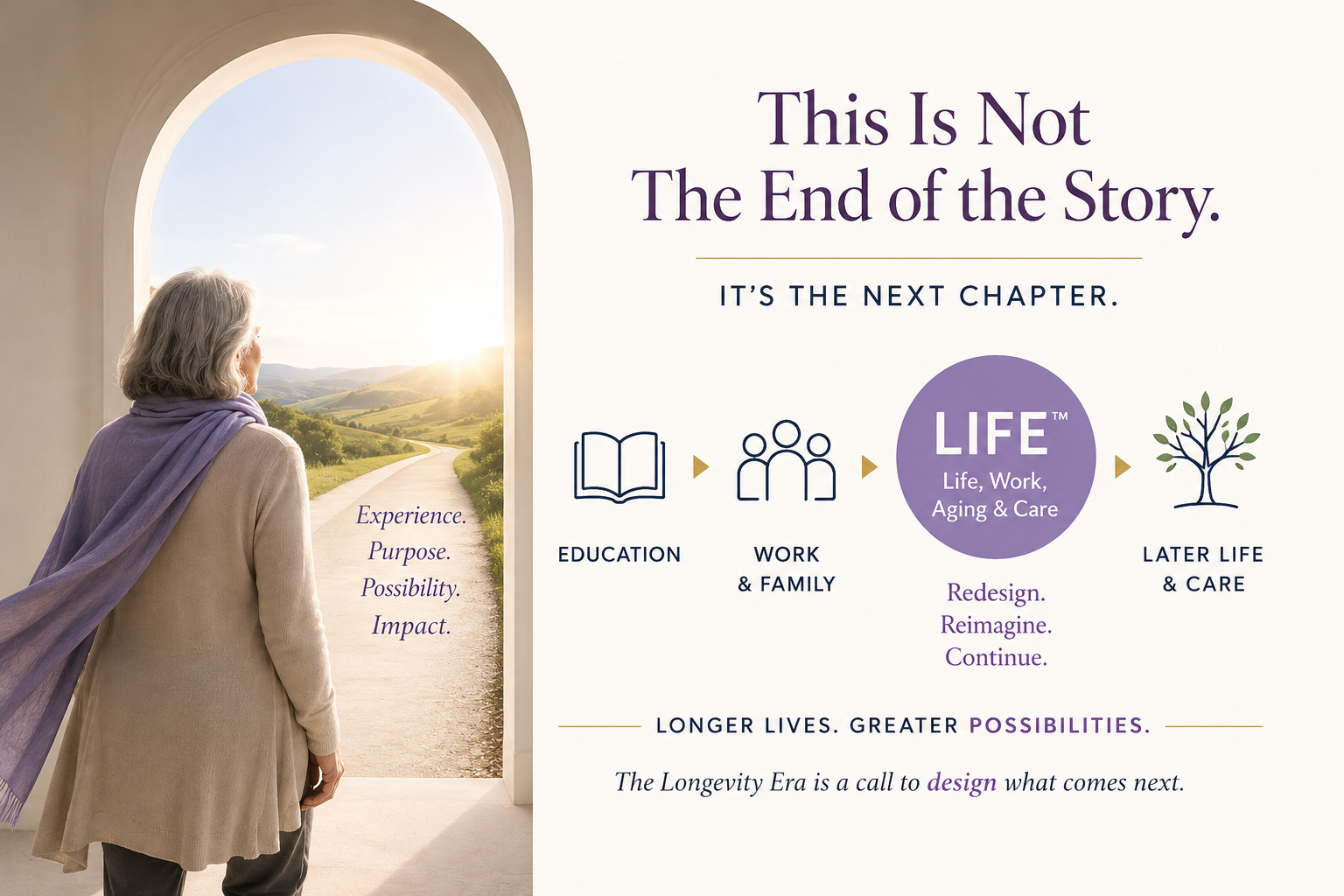
Education → Work & Family → Retirement → Later Life
I believe that model is becoming obsolete.
Longevity has created space for another stage:
Education → Work & Family → LIFE™ → Later Life & Care
LIFE™—Life, Work, Aging & Care—is not another word for retirement.
It is an emerging period of adulthood in which work, learning, relationships, contribution, aging, care and personal ambition can take entirely new forms.
For women, the timing is remarkable.
Women now entering this stage spent their lives transforming what was possible in education, employment, business, family life and leadership. But LIFE™ isn’t only about executives or women with advanced degrees.
Women arrive with accumulated capability from everywhere: workplaces, homes, businesses, professions, trades, schools, communities, faith organizations and civic life.
The asset is what someone has learned how to do.
And we are wasting too much of it.
Stop Planning the Exit. Start Designing What’s Next.
Employers should ask a different question. Instead of assuming an experienced employee is approaching an expiration date, ask: Where could her experience create value now? Transformation projects, mentoring, customer relationships, problem-solving, knowledge transfer, coaching, flexible work and entirely different roles can turn accumulated experience into an organizational asset.
Education should actively recruit this generation. Universities already offer lifelong learning. Community colleges, vocational programs and other educators can join them in marketing much more intentionally to women seeking new skills, AI fluency, entrepreneurship, new occupations or simply a new intellectual challenge.
Schools can use experienced adults differently. Imagine former businesspeople coaching student entrepreneurs, healthcare professionals introducing health careers, tradespeople connecting students to apprenticeships, financial professionals teaching financial literacy, or experienced adults serving as tutors, mentors and project leaders. Public education needs human capacity. Communities already have it.
Communities can create new structures for contribution. Faith organizations, libraries, municipalities, nonprofits, businesses and public institutions can invite experienced adults to become more than volunteers or program participants.
Become a designer. Coach. Mentor. Operator. Leader.
And people don’t have to wait for an institution to create the role.
Build a team. Find a problem. Design a solution. Approach an institution with an opportunity.
Baby Boomers spent decades building organizations, adapting to extraordinary technological and social change, managing crises and getting results.
Why would those capabilities suddenly become less valuable at 65?
We Also Have to Change What Age Means
Institutions alone cannot do this.
Each of us has to change our own picture of 70 and 80.
So does healthcare. So do employers. So does media.
Healthy aging should mean more than managing disease and avoiding decline. It should include the ability to choose, participate, contribute, connect, learn and continue becoming.
The objective is not to persuade women to work longer.
It is agency.
Retire. Work differently. Start something. Learn something. Teach something. Lead something. Travel. Create. Rest. Care. Build a business. Solve a community problem. Do several at once.
Seventy is an age—not an instruction about how to live.
We spent the last century adding years to life.
Now comes the more consequential opportunity: redesigning our institutions, communities and expectations so people can decide what those years become.
Longevity gave us the years. LIFE™ is about designing the life within them.
AUTHOR / CONTACT
Jeannette Galvanek | Founder & CEO, CareWise Solutions, Inc.
Je*******@***************ns.com | CareWiseSolutions.org
Part of the LIFE™ (Life, Work, Aging & Care) Framework
© 2026 CareWise Solutions, Inc. All Rights Reserved.